
Cattle breed profile
Hereford
Origin : England, United Kingdom — Herefordshire and neighbouring counties in western England
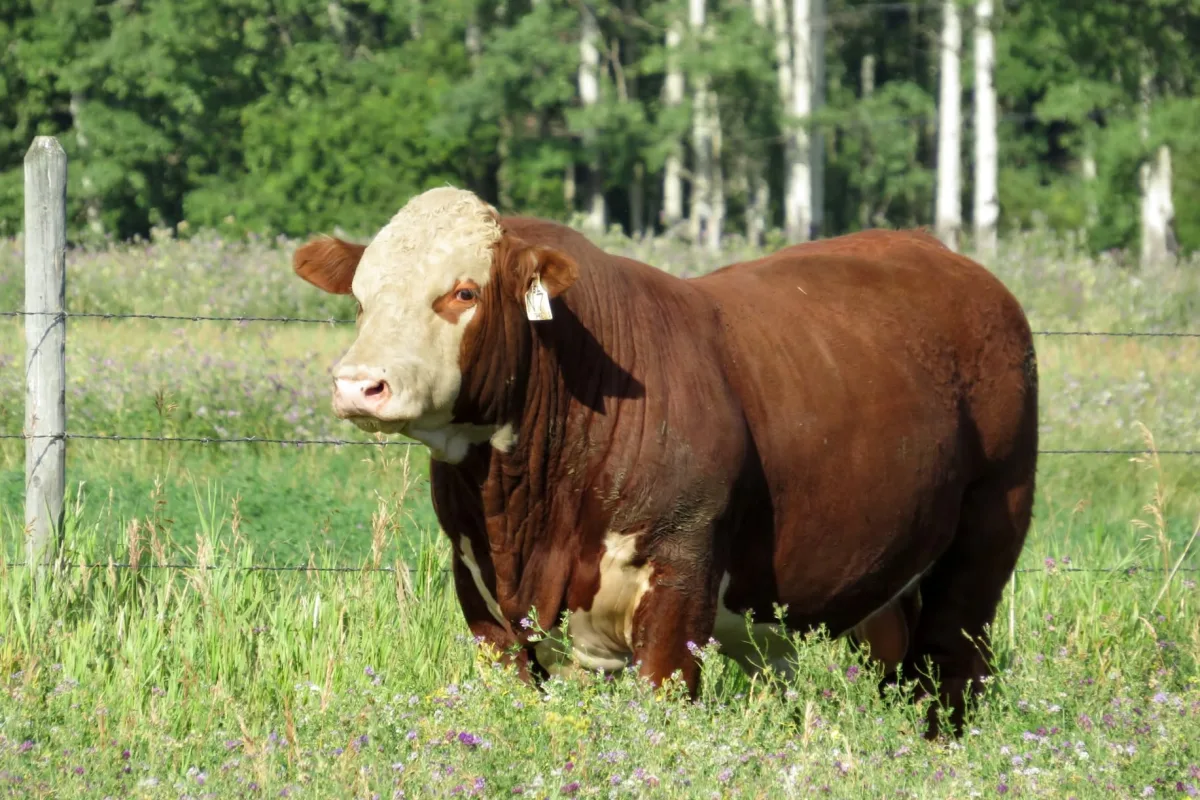
How can this breed be identified?
The Hereford is a deep-bodied, broad and well-muscled beef animal. It has a long, level back, well-sprung ribs and a wide hindquarter, while retaining a balanced and functional appearance without excessive coarseness.
Its colour pattern is the main identifying feature. The body is a deep rich red, while the face, crest, brisket, underline, lower legs and tail switch are white. Some animals show red pigmentation around the eyes without losing the characteristic white face.
Two main types occur. Traditional Herefords are horned, with pale horns generally spreading outwards before turning slightly forwards or downwards. Polled Herefords are naturally hornless. In both types, the head is broad, the muzzle is wide and the eyes are well protected.
A white face alone is not enough to identify the breed. Look also for the mainly red body, white underline and extremities, and compact beef conformation.
Overview, origin and history
Hereford cattle originated in Herefordshire and neighbouring counties in western England, close to the Welsh border. Cattle from this area were already known in the seventeenth and eighteenth centuries for their size, hardiness and ability to produce beef from grass.
From 1742, Benjamin Tomkins is generally credited as one of the principal founders of the modern breed. His breeding goals included economical feeding, the ability to grow on grass and grain, hardiness, early maturity and reliable reproduction. The white face and deep-red coat had become established by the end of the eighteenth century.
The first Hereford herd book was published by Thomas Eyton in 1846. The Hereford Cattle Society was founded in 1878, and from 1886 the herd book was closed to animals whose sire or dam had not already been recorded.
The breed subsequently spread far beyond the United Kingdom. Herefords were introduced to Ireland in 1775, the United States in 1817 and Australia in 1825. According to the Hereford Cattle Society, Hereford cattle have been exported to more than 120 countries, making the breed one of the best-known beef breeds in the world.
The naturally hornless variety, known as the Polled Hereford, was developed in the United States at the beginning of the twentieth century. Warren Gammon searched for and assembled registered Herefords that had been born naturally polled in order to establish this trait. Horned and polled cattle are now two types within the same breed and share the same distinctive markings.
Hereford cattle are valued for hardiness, a generally calm temperament, fertility, longevity, calving ease and the ability to produce beef from forage-based diets. They are used both as purebred cattle and in crossbreeding, as suckler cows or terminal sires. Hereford beef is particularly valued for its eating quality and marbling.
Identification hint
Look for a red beef animal with a white face, white underline, white lower legs and a white tail switch. It may be horned or naturally polled.
Institutional references
Other institutional reference
Department for Environment, Food & Rural Affairs et Hereford Cattle Society
- Reference name
- Hereford
- Reference country
- Royaume-Uni
Official text
Légifrance
- Reference name
- Hereford
Sources and contributions
Canadian Hereford Association
Source title : Breed History
Overview and history · Visual identification · English translation
Hereford Cattle Society
Source title : Our history — How the Hereford breed has stood the test of time
Overview and history · English translation
Hereford Cattle Society
Source title : The breed
Overview and history · Key facts · English translation
South African Hereford Cattle Society
Source title : Hereford Breed Standards and General Conformation Features
Identification hint · Visual identification · Key facts · English translation
Profile validations
Défi Races bovines
Approved description
Copper-T Ranch
Approved photographs
Holden Herefords
Approved photographs