
Cattle breed profile
Charbray
Origin : Australia — Queensland, especially Gatton
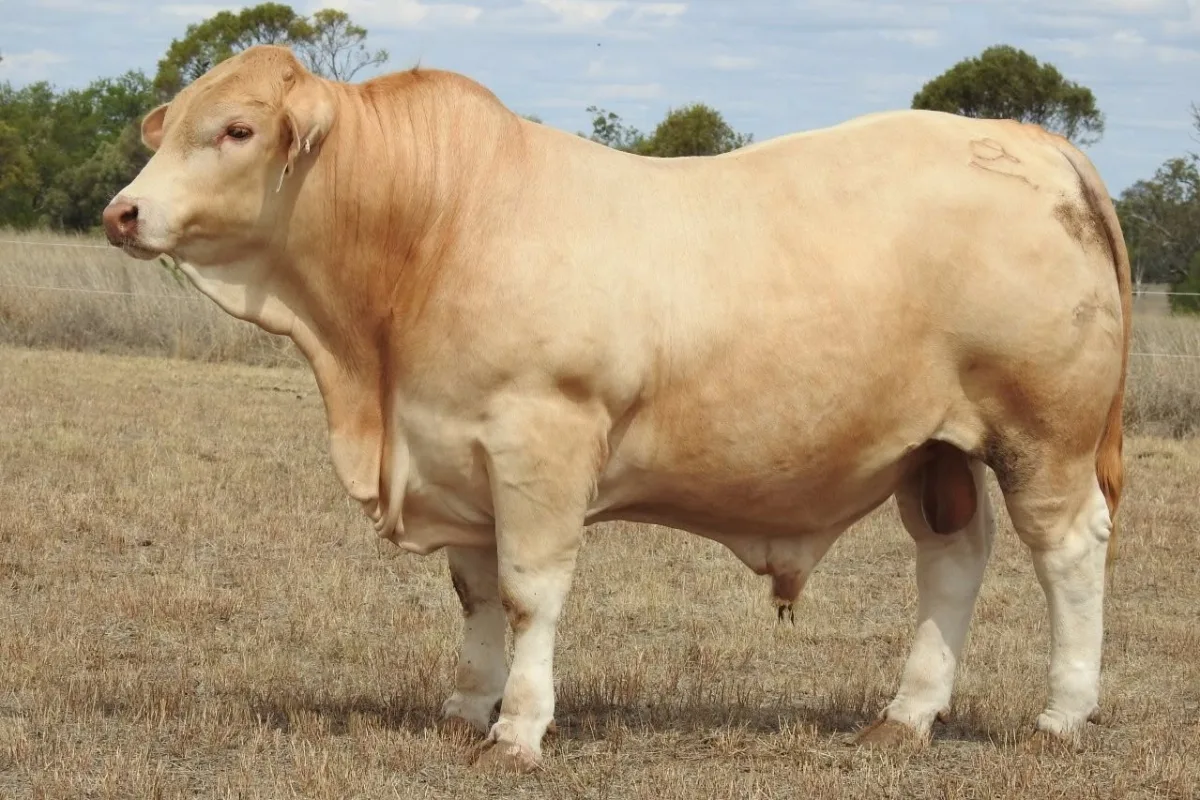
How can this breed be identified?
The Australian Charbray combines characteristics of the Charolais and Brahman breeds. It is a robust, medium to large beef animal with a deep body, strong topline and well-developed muscling, particularly over the loin and hindquarters.
The coat is solid and may range from white to red, with many cream or wheaten shades. Black, brindle and dark grey cattle are not accepted by the Australian breed standard. The skin should be pigmented, loose and pliable, and the coat is short and sleek.
The head is broad, with a wide muzzle, strong lower jaw and well-protected eyes. The ears are medium to large and may be straight or slightly drooping. Brahman influence may be visible in the looser skin, dewlap and ear shape, while the hump is generally slight or absent. Desirable animals are docile but alert.
Overview, origin and history
The Charbray is a beef cattle breed developed by combining Charolais cattle, known for growth, muscling and carcass performance, with Brahman cattle, adapted to hot climates and difficult farming conditions.
In Australia, the first crosses were produced at Gatton Agricultural College in Queensland. Brahman cows were inseminated in 1969 with semen from French Charolais bulls, and the first Charolais × Brahman calves were born during the summer of 1969-1970. A specific Australian organisation for Charbray cattle gradually developed during the 1970s.
The Australian breeding plan is deliberately flexible. To be registered as Charbray, an animal must contain between 25 and 75 per cent Charolais ancestry and between 25 and 75 per cent Brahman or other Bos indicus ancestry accepted under the Australian breeding plan. This flexibility enables breeders to adapt their cattle to local environments. More Brahman influence may be used in harsher conditions, while Charolais influence may be increased in more favourable environments.
Selection aims to combine the Brahman’s hardiness, heat, tick and parasite tolerance, mobility and ability to forage under difficult conditions with the Charolais breed’s growth, muscling, carcass yield and calmer temperament.
Calves generally have moderate birth weights followed by rapid growth and strong weaning performance. Charbray cattle can perform on grass or under more intensive grain-feeding systems. Females are valued for fertility, maternal ability and their capacity to rear a calf under stressful conditions.
Thanks to its tolerance of heat and drought, the Charbray is especially suited to tropical and subtropical regions. It is also used in crossbreeding to improve growth, muscling and carcass performance while maintaining adaptation to hot environments.
Identification hint
Look for a muscular white, cream, wheaten or red beef animal with a short sleek coat, pliable skin and visible Brahman influence, but little or no hump.
Sources and contributions
Charbray Society of Australia Ltd
Source title : Charbray Breed Attributes
Identification hint · Game · Overview and history · Visual identification · Key facts · English translation
Charbray Society of Australia Ltd
Source title : The Charbray Standard of Excellence
Identification hint · Game · Visual identification · Key facts · English translation
Charbray Society of Australia Ltd
Source title : Charbray Breeding Plan
Overview and history · Key facts · English translation
Charbray Society of Australia Ltd
Source title : Charbray Breed History
Overview and history · English translation
Profile validations
Wattlebray Charbrays
Approved photographs
Huntington Charbray
Approved photographs · Approved description · Identification hint · Game · Overview and history · Visual identification · Key facts · English translation